How to calculate Shadows: Difference between revisions
Jump to navigation
Jump to search
No edit summary |
No edit summary |
||
| (15 intermediate revisions by the same user not shown) | |||
| Line 1: | Line 1: | ||
[[ | <youtube>LhBTMepbi38</youtube> | ||
[[Shade result type (Shadow Overlay)|Shadows]] can be calculated by either the [[Shadow Overlay]] or the [[Heat Overlay]]. In case only Shadows are of importance, follow this how-to to add and setup a Shadow Overlay. More configuration options are provided at the end. | |||
{{howto|title= | {{howto|title= | ||
|Select [[Current Situation]] in the [[ribbon bar]] | |Select [[Current Situation]] in the [[ribbon bar]] | ||
|Hover over [[Overlay]]s and under Environmental, select | |Hover over [[Overlay]]s and under Environmental, select Shadow. | ||
|With the Shadow Overlay selected, click on the Configuration Wizard button to open the Shadow Wizard. | |With the [[Shadow Overlay]] selected, click on the Configuration Wizard button to open the Shadow Wizard. | ||
| | |Once the Shadow Wizard has initialized, click next to begin. | ||
|In the | |In the Select Days step, click on the edit button and select a start and optional end date and select which hours of the day should be calculated. | ||
|Click next to confirm | |Click next to confirm. | ||
|In the Hour | |In the Hour Values step, inspect the chosen dates and hours of day and continue. | ||
|In the | |In the Elevation step, select the default option: use Digital Terrain and Surface Model for elevation and click next. | ||
|In the Foliage Step, select the option | |In the Foliage Step, select the default option Tree Function's height and click next. | ||
|In the | |In the Foliage Function Step, optionally inspect Function values and click next. | ||
|With the wizard closed, click on the Update link in the Shadow Overlay Detail Panel | |In the Visualize Crown Factor, optionally select the Foliage Crown Factor option and click next. | ||
|Inspect the Overlay by clicking on the play button in the Overlay | |In the continue to the Output Overlays Step and finish the wizard. | ||
|With the wizard closed, click on the Update link in the Shadow Overlay Detail Panel. | |||
|Inspect the Overlay by clicking on the play button in the [[Overlay legend panel]]. | |||
}} | }} | ||
<gallery> | |||
File:Shadow_date_selection.jpg|Select a start and end date. | |||
File:Shadow_result_tooltip.jpg|Tooltip of calculated shadow overlay. | |||
</gallery> | |||
{{article end | {{article end | ||
|notes= | |notes=*[[Grid Overlay]]s can be used to provide an alternative [[Building elevation prequel (Shadow Overlay)|Building]] and/or [[Terrain elevation prequel (Shadow Overlay)|Terrain Elevation prequels]], as well as [[Foliage height prequel (Shadow Overlay)|Foliage Height]]. | ||
* | |||
|seealso= | |seealso= | ||
*[[Shadow Overlay]] | |||
*[[Shade result type (Shadow Overlay)]] | |||
|howtos= | |howtos= | ||
}} | }} | ||
{{ShadowOverlay nav}} | |||
Latest revision as of 08:31, 17 October 2025
Shadows can be calculated by either the Shadow Overlay or the Heat Overlay. In case only Shadows are of importance, follow this how-to to add and setup a Shadow Overlay. More configuration options are provided at the end.
How to calculate Shadows:
- Select Current Situation in the ribbon bar
- Hover over Overlays and under Environmental, select Shadow.
- With the Shadow Overlay selected, click on the Configuration Wizard button to open the Shadow Wizard.
- Once the Shadow Wizard has initialized, click next to begin.
- In the Select Days step, click on the edit button and select a start and optional end date and select which hours of the day should be calculated.
- Click next to confirm.
- In the Hour Values step, inspect the chosen dates and hours of day and continue.
- In the Elevation step, select the default option: use Digital Terrain and Surface Model for elevation and click next.
- In the Foliage Step, select the default option Tree Function's height and click next.
- In the Foliage Function Step, optionally inspect Function values and click next.
- In the Visualize Crown Factor, optionally select the Foliage Crown Factor option and click next.
- In the continue to the Output Overlays Step and finish the wizard.
- With the wizard closed, click on the Update link in the Shadow Overlay Detail Panel.
- Inspect the Overlay by clicking on the play button in the Overlay legend panel.
-
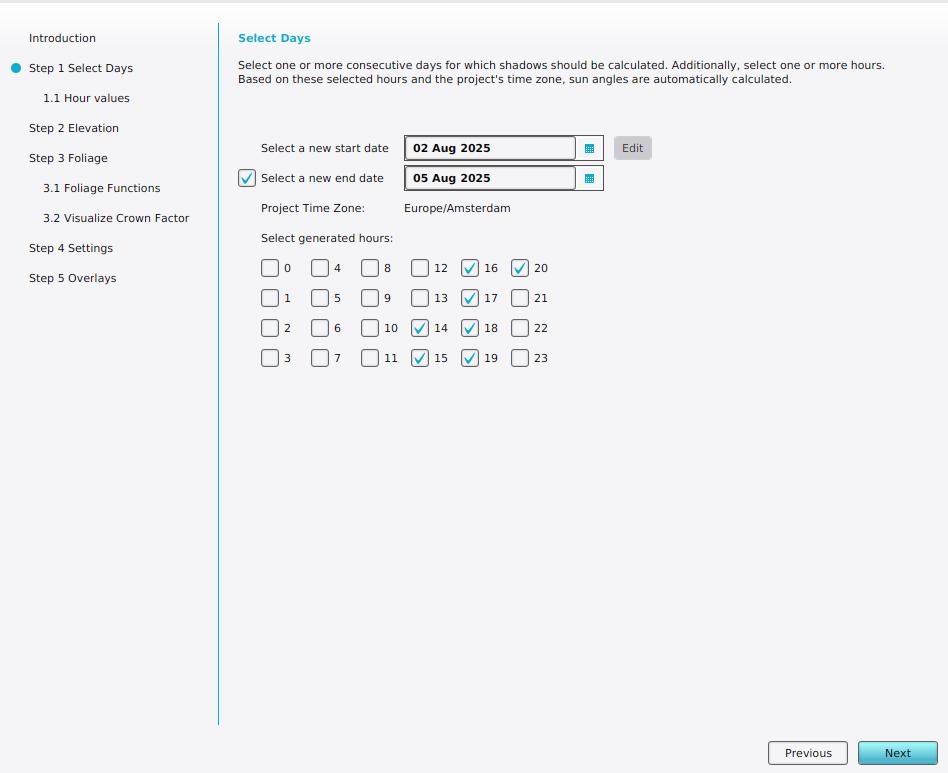 Select a start and end date.
 -
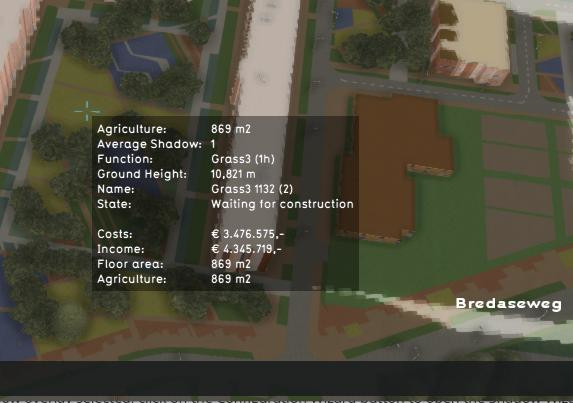 Tooltip of calculated shadow overlay.


Notes
- Grid Overlays can be used to provide an alternative Building and/or Terrain Elevation prequels, as well as Foliage Height.
See also