How to export AI Training Data: Difference between revisions
Jump to navigation
Jump to search
No edit summary |
No edit summary |
||
| (12 intermediate revisions by 3 users not shown) | |||
| Line 1: | Line 1: | ||
<youtube>Zue3st3zdUY</youtube> | |||
This how-to explains how to generate an AI Training Data using the {{software}}. This data can be used to train your [[How to train your own AI model for an Inference Overlay|own AI model]]. | This how-to explains how to generate an AI Training Data using the {{software}}. This data can be used to train your [[How to train your own AI model for an Inference Overlay|own AI model]]. | ||
{{editor steps|title= | {{editor steps|title= | ||
| Open a project in editor mode using the Tygron Client Application | | Open a project in editor mode using the Tygron Client Application | ||
| Optionally add a [[Satellite Overlay]]. This overlay will be used to export train images for the dataset. | | Optionally add a [[Satellite Overlay]]. This overlay will be used to export train images for the dataset. | ||
| Determine what [item] type will be used to export a dataset for. For example [[area]]s drawn on top of the satellite overlay. | | Determine what [item] type will be used to export a dataset for. For example Foliage [[area]]s drawn on top of the satellite overlay. | ||
| Select the ''Export Geo Data'' option in the Ribbon bar popup of the selected item type. For example: Hover over Areas and select ''Export Geo Data'' | | Select the ''Export Geo Data'' option in the Ribbon bar popup of the selected item type. For example: Hover over Areas and select ''Export Geo Data'' | ||
| Under ''Format'', select the option '''AI Training Data''' | | Under ''Format'', select the option '''AI Training Data PNG''' | ||
| | | Filter items with an attribute, such as '''FOLIAGE''' | ||
| Optionally select a prepared Intersection Area, for example a '''TRAIN_LIMIT_AREA'''. | |||
| For the Overlay, select the preferred Overlay, for example the [[Satellite Overlay]]. | | For the Overlay, select the preferred Overlay, for example the [[Satellite Overlay]]. | ||
| The image size can increased, as long as the amount of expected features within the image does not exceed the maximum amount of 250. | | The image size can increased, as long as the amount of expected features within the image does not exceed the maximum amount of 250. | ||
| Line 16: | Line 19: | ||
}} | }} | ||
<gallery> | |||
File:export_ai_training_data_export_config.png|Configuration of the Export AI Training Data as PNG's for Foliage [[Areas]] on a [[Satellite Overlay]], with an intersecting area. | |||
</gallery> | |||
{{article end | {{article end | ||
|notes=* In case the export folder is not empty, a confirmation popup will appear on overriding the existing image, label, mask and bounding box files. | |||
* In case a region intersects the limit area, but does not contain any features, it is still exported as a dataset-entry (image-, label-, mask- and bbox-file) but without labels, mask pixels or bounding box entries. | |||
* In case the feature density is low, the image size can be increased. | |||
* In case the feature sizes are small compared to the image size, the stride can be increased. | |||
* A dataset can also be generated as '''AI Training Data CSV''', which allows users to directly train on float matrices instead of color images. | |||
* When the intended background image is not the satellite image provided by default but some other image or set of data, it is also possible to select a [[WMS Overlay]] referencing an external map service, or a [[Combo Overlay]], the <code>COLOR</code> function of which can be used to compute a custom image with. | |||
|howtos= | |howtos= | ||
* [[How to train your own AI model for an Inference Overlay]] | * [[How to train your own AI model for an Inference Overlay]] | ||
| Line 23: | Line 35: | ||
* [[Demo Training Data Project]] | * [[Demo Training Data Project]] | ||
* [[PyTorch]] | * [[PyTorch]] | ||
* [[Satellite Overlay]] | |||
}} | }} | ||
Latest revision as of 12:59, 17 October 2025
This how-to explains how to generate an AI Training Data using the Tygron Platform. This data can be used to train your own AI model.
How to export AI Training Data:
- Open a project in editor mode using the Tygron Client Application
- Optionally add a Satellite Overlay. This overlay will be used to export train images for the dataset.
- Determine what [item] type will be used to export a dataset for. For example Foliage areas drawn on top of the satellite overlay.
- Select the Export Geo Data option in the Ribbon bar popup of the selected item type. For example: Hover over Areas and select Export Geo Data
- Under Format, select the option AI Training Data PNG
- Filter items with an attribute, such as FOLIAGE
- Optionally select a prepared Intersection Area, for example a TRAIN_LIMIT_AREA.
- For the Overlay, select the preferred Overlay, for example the Satellite Overlay.
- The image size can increased, as long as the amount of expected features within the image does not exceed the maximum amount of 250.
- The stride can be kept at 50%
- Click on the Export Files button
- Select a suitable folder for the generated dataset.
- Wait until the dataset is fully generated.
-
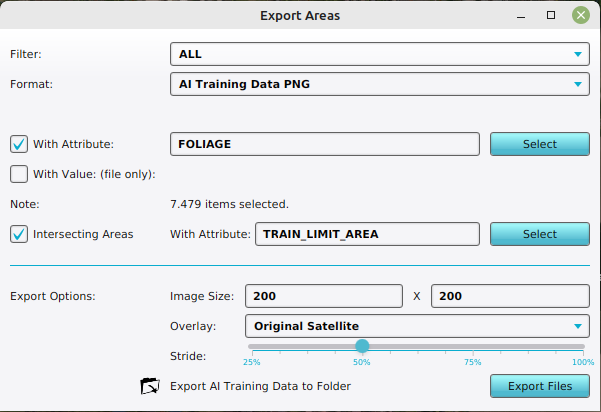 Configuration of the Export AI Training Data as PNG's for Foliage Areas on a Satellite Overlay, with an intersecting area.

Notes
- In case the export folder is not empty, a confirmation popup will appear on overriding the existing image, label, mask and bounding box files.
- In case a region intersects the limit area, but does not contain any features, it is still exported as a dataset-entry (image-, label-, mask- and bbox-file) but without labels, mask pixels or bounding box entries.
- In case the feature density is low, the image size can be increased.
- In case the feature sizes are small compared to the image size, the stride can be increased.
- A dataset can also be generated as AI Training Data CSV, which allows users to directly train on float matrices instead of color images.
- When the intended background image is not the satellite image provided by default but some other image or set of data, it is also possible to select a WMS Overlay referencing an external map service, or a Combo Overlay, the
COLORfunction of which can be used to compute a custom image with.